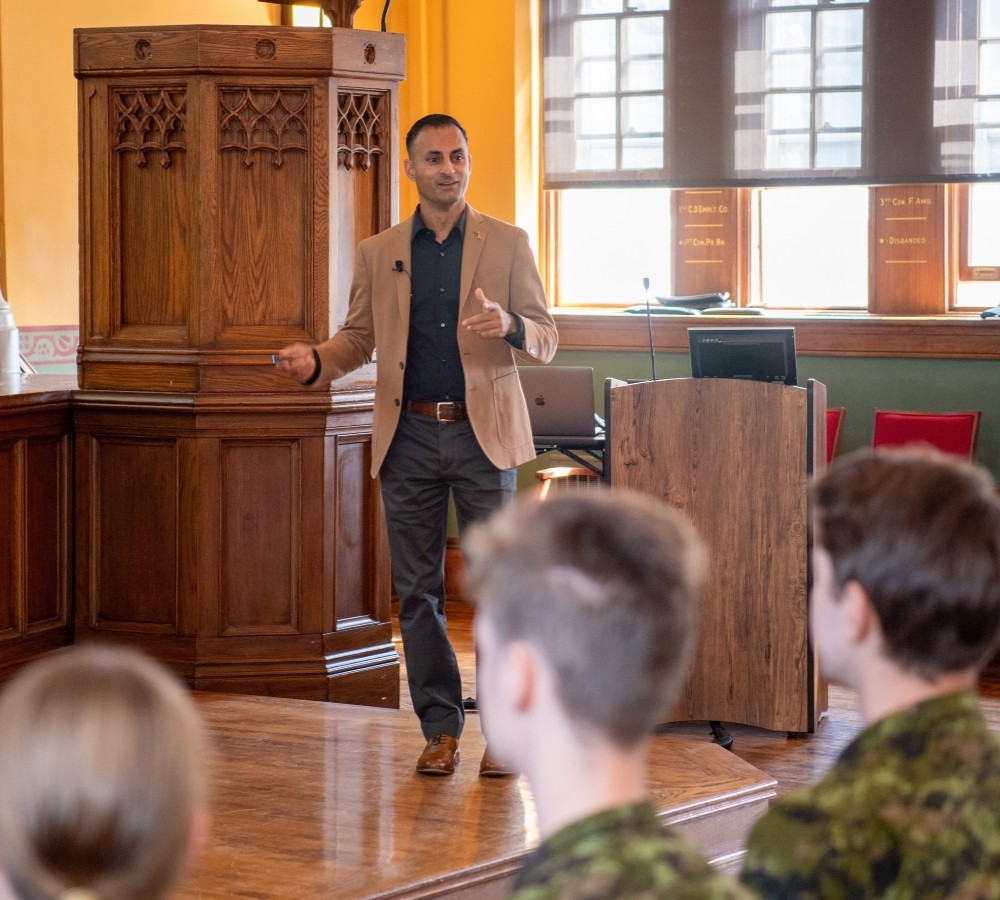
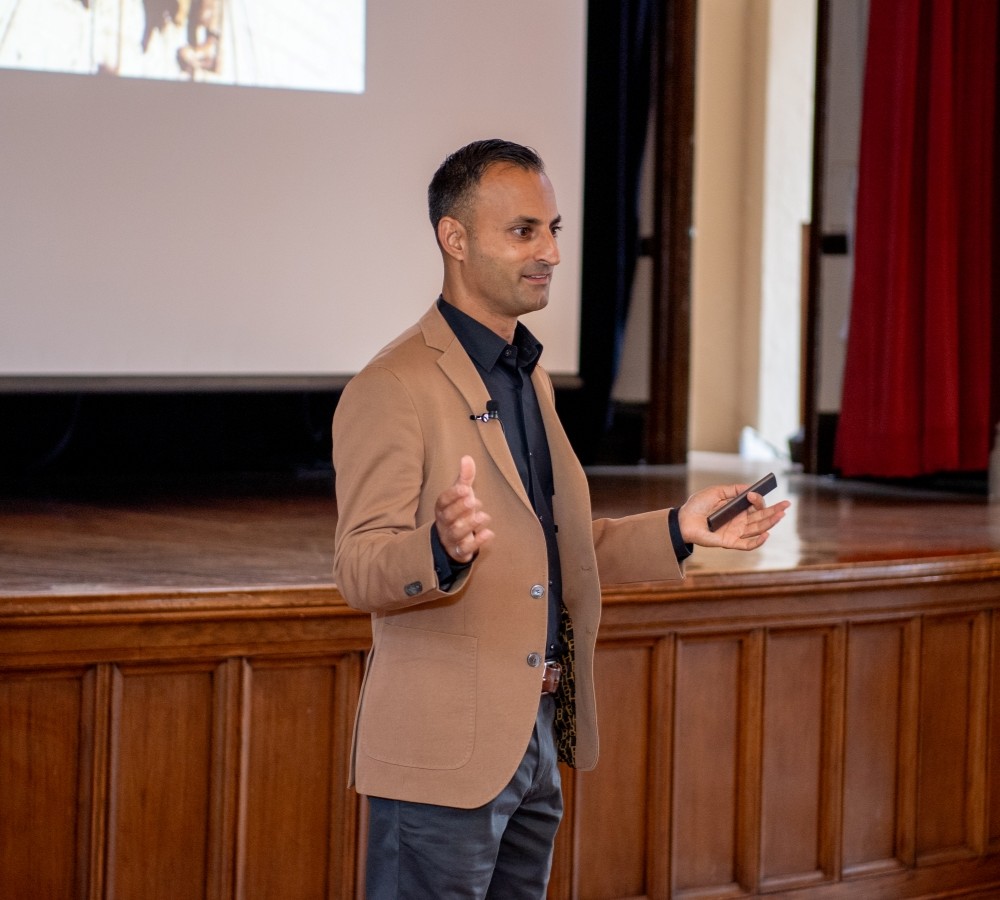
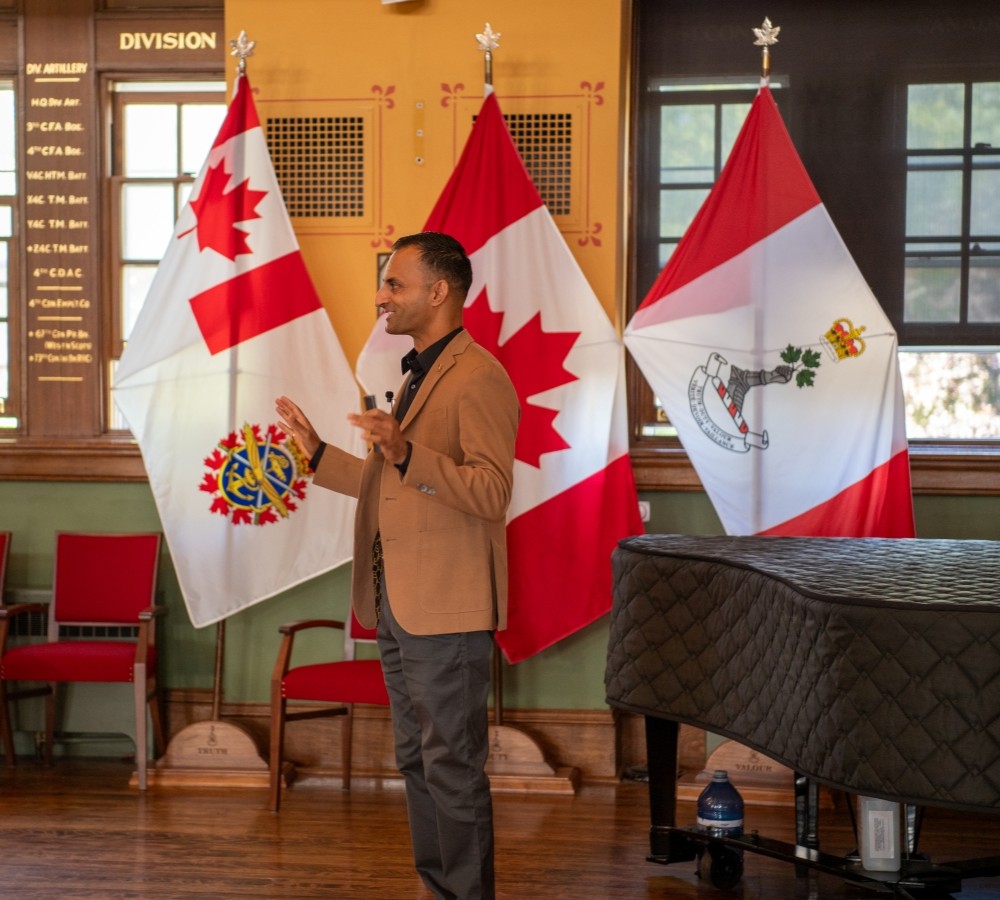


On 12 September 2025, the RMC Physics and Space Science department was proud to host a public lecture by Maj (retired) Jameel Janjua, an ex-cadet who graduated with a Chemical and Material Engineering Degree in 2000. He was able to describe to the audience how he was been able to take the foundational skills he developed in his years at RMC to become a fighter pilot within the RCAF, and a test pilot. These experiences then led him to become a 2009 finalist in the Canadian Space Agency’s astronaut recruitment campaign, placing among the last four from a pool of over 5,000 applicants. Not to be deterred from his aspirations for space, he took these experiences and became a pilot for Virgin Galactic, where he was able to fly up to a height of 287,011 ft (87,481 m) with a maximum speed of Mach 2.96.
Physics and Space Science News and Events
2025 Physics for Defence Lecture
2025-03-21
The Royal Military College's Annual Physics for Defence Lecture 2025 will be presented in
Sawyer Theatre (S 1303)
by Dr. Ron Vincent
on 27 March 2025, 10:00 - 12:00.
Audimus: RMC's CubeSat Mission for Arctic Research and Sovereignty

Annual Physics for Defence Lecture 2024
2024-02-26
The Royal Military College's Annual Physics for Defence Lecture 2024 will be presented in Sawyer Theatre (S 1303) by Dr. Gregg Wade on 4 March 2024, 14:40 - 15:30.
Public Lecture: "Living in the shadow of a monster: Magnetic activity of the Sun and the terrestrial space environment".
Contact: LCdr Steve Semenuk steve.semenuk@rmc.ca
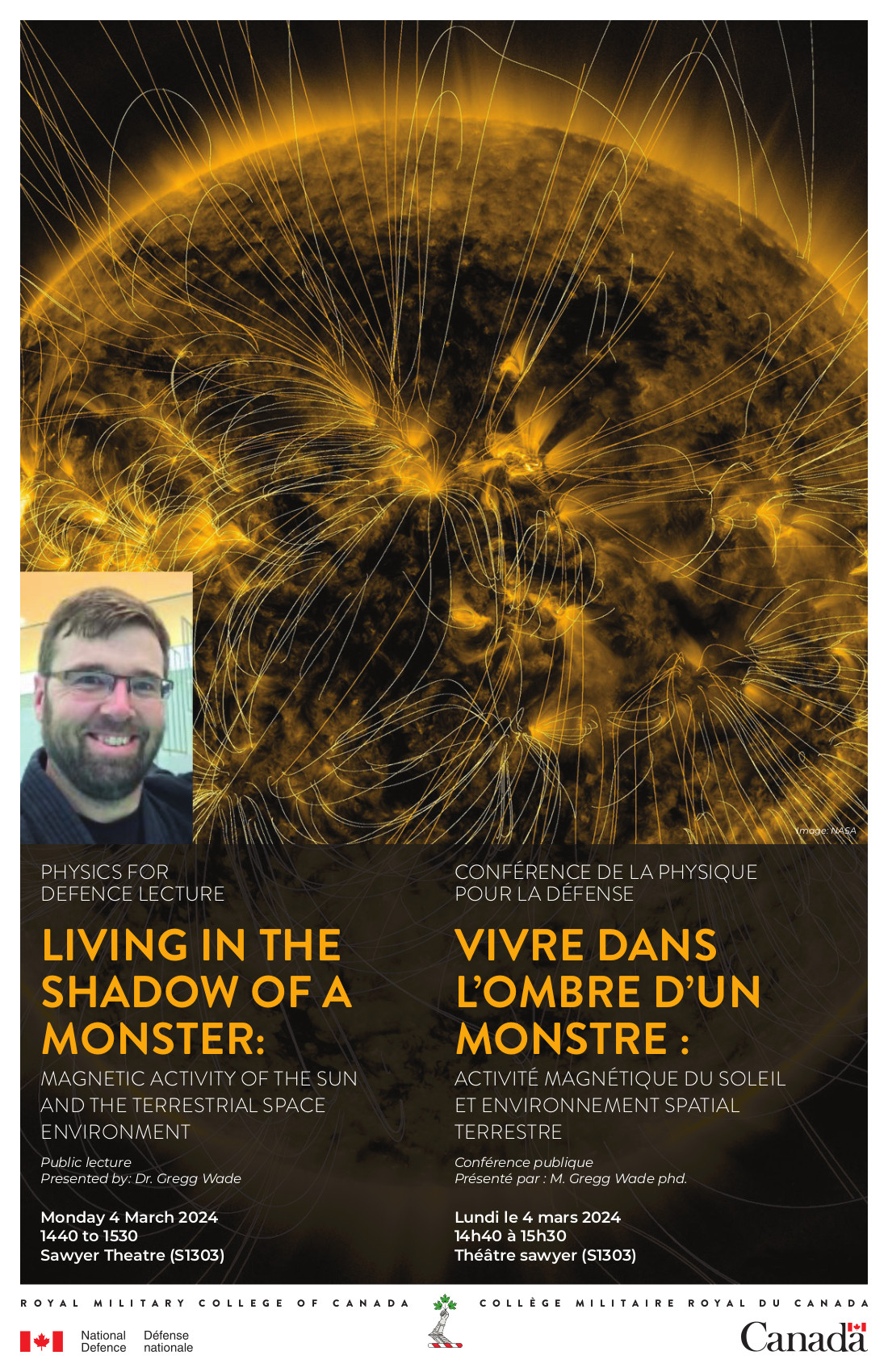
The Sun is a convecting, rotating ball of plasma that generates intense magnetic fields deep in its interior. As these fields appear at the solar surface they are stressed and torn by powerful fluid motions, leading to violent reconnection and energy release events. the resultant explosions produce storms of particles and radiation that propagate through the solar system. This presentation will describe the general characteristics of solar activity, and discuss in some detail the impacts of that activity on the Earth’s near space environment. We will also briefly discuss examples of other solar system planets and exotic exoplanetary systems exhibiting star-planet interactions.